Open Research Projects
The PURA Syndrome Foundation would like to encourage PURA Caregivers and Patients to participate in research studies when they become available. The PURA Foundation is not always affiliated with or sponsors these studies – we share them for informational purposes and for the benefit of our children, and all questions should be directed to the person conducting the research study.

Current Projects
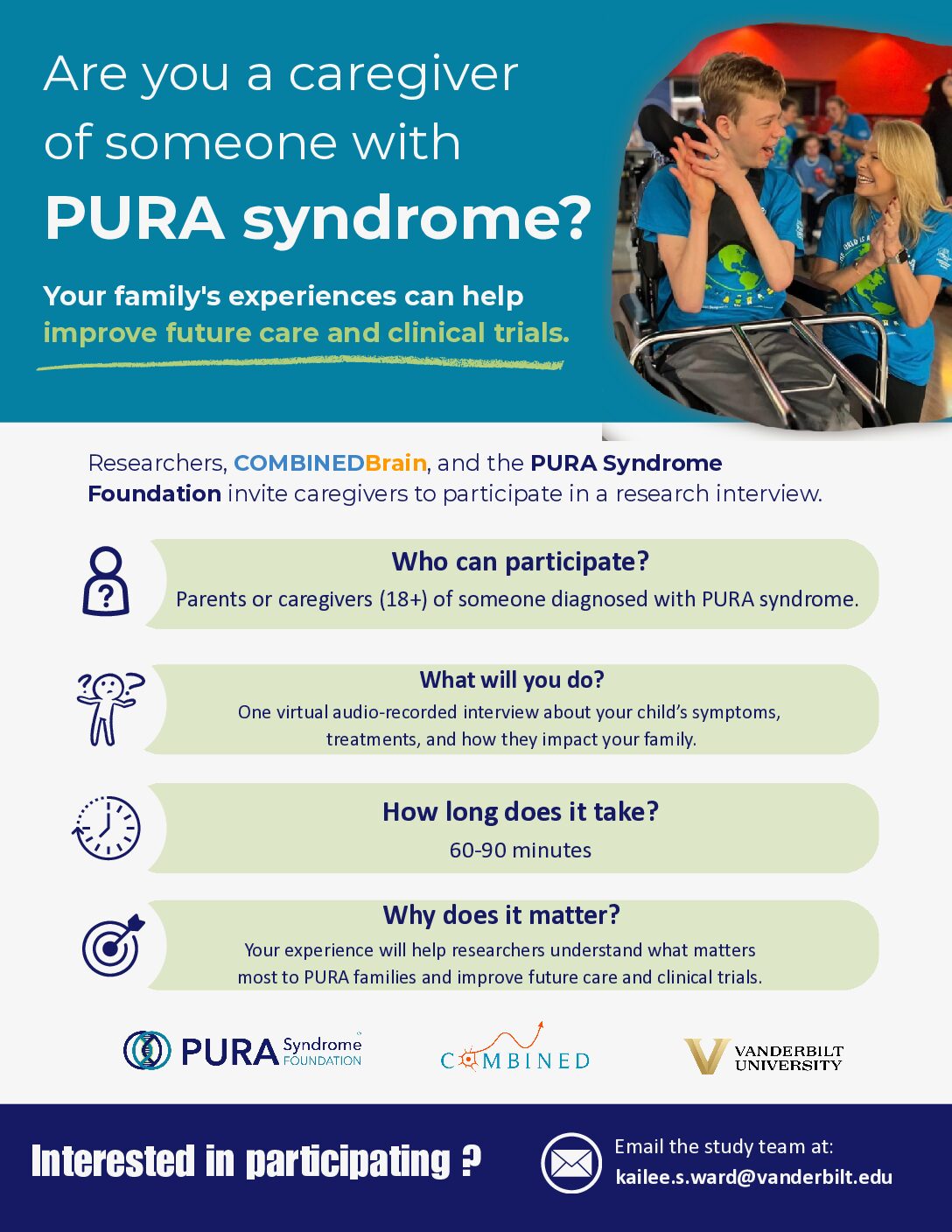
PURA Syndrome Disease Concept Model
**This is open to all PURA caregivers worldwide**
If you’re interested in participating or learning more, please email the study team at: kailee.s.ward@vanderbilt.
Volumetrics Study in Rare Disorders
**This is open to all PURA individuals worldwide**
Dr. Waugh is a pediatric neurologist and neuroscientist at UT Southwestern, in Dallas, Texas, USA. He uses MRI scans to understand how the brain is made differently in genetic syndromes. For many syndromes, including PURA, the brain MRI looks pretty normal. But when he combines groups of patients and compares them to groups of typically developing kids, he has found more subtle brain differences. By finding these syndrome-specific brain differences, the hope is that we can better understand why changes in the PURA gene cause the features of this syndrome.
What would you need to do?
If you’re interested in learning more, please email Dr. Waugh’s research coordinator, Ms. Alyssa Boudreau (alyssa.boudreau@
All research will be carried out anonymously – nothing would be shared with others, and nothing would be published that could identify your child.
Developmental and Epileptic Encephalopathy Research (DEER) study for PURA Syndrome
**This is open to all PURA individuals worldwide**
PURA clinical epilepsy research published in 2021 highlighted the need for additional studies focussed on PURA epilepsy. Through this Developmental and Epileptic Encephalopathy (DEE) Study, we aim to understand the common PURA syndrome clinical characteristics to determine possible treatment requirements and define outcome markers necessary for future clinical trials.
Key research aims are to define the spectrum of PURA epilepsy, describing and comparing seizures and non-epileptic events seen in PURA syndrome. This includes looking at the types, frequency, patterns and severity of seizures, as well as other related issues like medications trialled, developmental delays, cognitive problems, and motor difficulties. PURA individuals with and without epilepsy can be involved.
Individuals with a confirmed diagnosis of PURA syndrome or 5q31.3 deletion syndrome (including PURA) are encouraged to join this study.