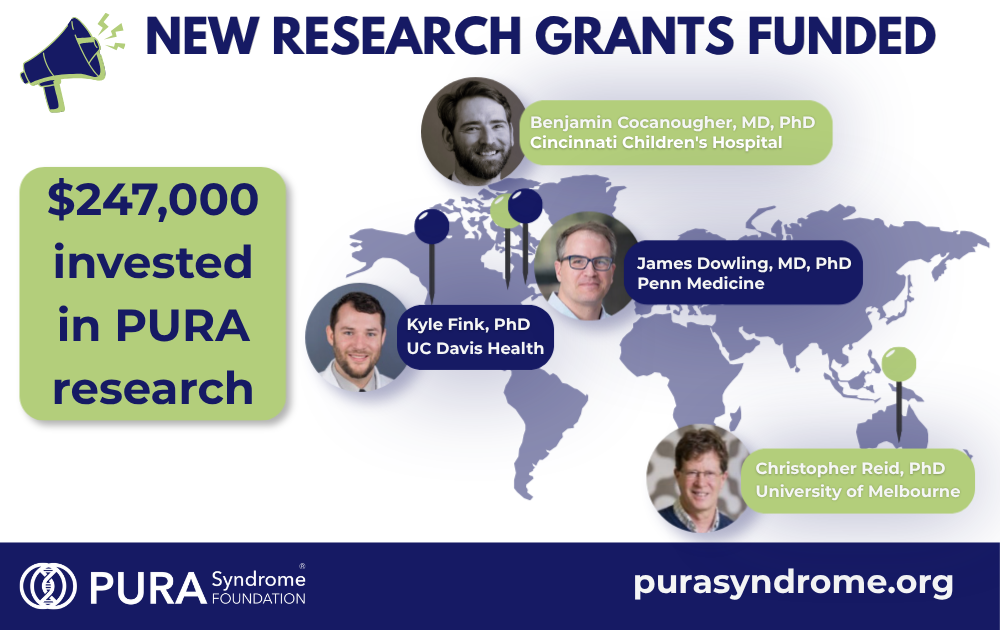
The PURA Syndrome Foundation is proud to announce the funding of four research grants totaling $247,000 in the inaugural year of the PURA Syndrome Foundation Grant Program. This marks the largest research investment in the Foundation’s 11-year history, which is a direct result of the generosity of donors who supported the Together for PURA 2024–2025 campaign, “Commemorating a Decade Since Discovery: Propelling Forward into the Future.”
The 2024–2025 campaign marked ten years since PURA syndrome was first identified as a named disorder in 2014 — the moment our families began receiving a diagnosis, and the moment a global community began to form around it. Ten years later, the PURA Syndrome Foundation is channeling that momentum directly into the science that will answer critical questions about PURA and ultimately identify medical interventions so urgently needed by our community.
From Commitment to Expansion
The Foundation’s board originally committed $200,000 to funding research in 2026. After reviewing the applications received through our 2025 PURA Syndrome Foundation Grant Program, the board voted to increase that commitment to $247,000 to fund four out of six exceptional research projects that were submitted in response to the request for proposals. The quality of the science, the caliber of the teams, and the potential impact of the work made the decision clear: this was the moment to invest at scale.
This expanded funding is in addition to the Foundation’s ongoing investments in our patient registry and biobank initiatives — the infrastructure that makes research like this possible.
How These Projects Were Chosen
The 2025 PURA Syndrome Foundation Grant Program awardees were painstakingly selected by weighing the input from three groups: the feedback and guidance from a panel selected from our Scientific Advisory Board, the priorities identified by PURA families themselves, and the findings of an independent scientific landscape analysis conducted by Odylia Therapeutics. Our Request for Proposals targeted research questions that were identified as critical gaps in our understanding of PURA Syndrome which included the biology of PURA-related seizures, the function of PURA at the neuromuscular junction, PURA’s molecular interactions and downstream pathways, and the mechanisms behind pain perception, temperature regulation, metabolism, bone health, and communication differences in PURA Syndrome.
The 2025 Grants
Professor Christopher Reid — Florey Institute of Neuroscience and Mental Health, University of Melbourne
Project focus: Uncovering the brain mechanisms behind PURA-related seizures
Seizures are one of the most severe and difficult‑to‑treat symptoms of PURA syndrome, yet we still don’t fully understand why they happen.
In this project, Professor Reid and his team are using a newly developed mouse model of PURA syndrome that closely mirrors the symptoms seen in patients, including movement difficulties, abnormal brain activity, and spontaneous seizures. By studying how brain cells and circuits function in this model, the team aims to uncover what causes the brain to become overly excitable and trigger seizures. Understanding these mechanisms is essential for developing better, targeted treatments.
This research will help identify new therapy targets and support future drug testing and precision medicine approaches, bringing us closer to safer and more effective treatments for individuals living with PURA syndrome.
 Professor Christopher Reid is an internationally recognized epilepsy researcher at the Florey Institute of Neuroscience and Mental Health, University of Melbourne. His research focuses on understanding why brain cells become over‑excitable in rare genetic epilepsies and on developing targeted therapies for severe, treatment‑resistant seizures. Professor Reid has developed a novel mouse model of PURA syndrome that closely mirrors key patient features, providing a critical platform to uncover seizure mechanisms and evaluate potential treatments. He holds a Mercator Fellowship within the German Research Foundation Consortium on Epileptogenesis of Genetic Epilepsies and holds senior leadership roles in international epilepsy organizations including a position on the ILAE Neurobiology Commission and co-chair of the Animal Modelling Committee. Through extensive national and international clinical collaborations, he helps bridge preclinical discovery to clinical translation. As Epilepsy and Neurodevelopment Priority Research Area Lead at the Florey, Professor Reid brings deep expertise in genetic epilepsy disease modeling and precision therapeutics directly relevant to improving outcomes for individuals living with PURA syndrome.
Dr. Benjamin Cocanougher — Cincinnati Children’s Hospital Medical Center / University of Cincinnati College of Medicine
Project focus: Investigating whether shortened PURA proteins actively disrupt cell function
PURA syndrome is a rare genetic condition that affects brain development, often leading to developmental delays, low muscle tone, and seizures. It is caused by changes in a gene called PURA, which plays an important role in how cells read and use genetic information.
Most current understanding suggests that PURA syndrome happens because the body does not make enough working PURA protein. However, new evidence, including findings from our lab, suggests that some genetic changes may produce a shortened (or “truncated”) version of the PURA protein that could actively interfere with normal cell function.
Our research aims to answer a key question: do these shortened proteins simply reduce function, or do they actually disrupt normal processes in a harmful way?
To address this, we will:
- Study how these altered PURA proteins behave inside cells
- Examine whether they interfere with normal genetic regulation
- Use patient-derived cells to understand how these changes affect brain cell development
This work is important because it could change how we think about treating PURA syndrome. If these shortened proteins are harmful, future therapies may need to do more than just increase normal PURA levels — they may also need to block or counteract the abnormal protein.
Ultimately, our goal is to better understand the disease so that we can help guide the development of effective, targeted treatments for individuals with PURA syndrome.
 Benjamin T. Cocanougher, MD, PhD, is a physician-scientist and Assistant Professor of Pediatrics in the Division of Human Genetics at Cincinnati Children’s Hospital Medical Center and the University of Cincinnati College of Medicine. He is a board-certified medical geneticist with advanced training in neuroscience, clinical genetics, and translational science, including a PhD from the University of Cambridge as a Gates Cambridge Scholar and postdoctoral research in biochemistry and clinical training in Genetics at Duke University. Dr. Cocanougher’s work centers on understanding brain development and translating these insights into new treatments for children with neurodevelopmental disorders. His research focuses on defining the molecular and cellular mechanisms underlying rare genetic conditions that affect the nervous system, with the goal of identifying targeted therapeutic strategies. In parallel with his research, he provides clinical care for children with complex genetic and neurologic conditions and leads an independent research laboratory dedicated to advancing precision medicine approaches for rare neurodevelopmental diseases. Through partnerships with patient advocacy groups including the PURA Syndrome Foundation, his work aims to accelerate the development of meaningful therapies that improve outcomes for affected children and their families.
Dr. Kyle Fink — University of California, Davis Health
Project focus: Building a “disease-in-a-dish” model of PURA syndrome using human stem cells
PURA syndrome is a rare genetic disease that affects how the brain develops, leading to differences in learning, communication, and movement. While we know that changes in the PURA gene cause PURA syndrome, we still don’t fully understand how those changes impact brain cells or how to treat them.
To answer these questions, our lab is creating a “disease-in-a-dish” model using human stem cells. This means we can grow brain cells in the lab and study how PURA mutations affect how those cells develop, connect, and communicate. By comparing cells with and without PURA mutations, we can begin to see what goes wrong during brain development.
Our goal is to understand the biology of PURA syndrome more deeply and identify measurable changes in brain cells that can be used to test potential treatments. This work lays the foundation for developing therapies in the future and brings us one step closer to improving the lives of individuals and families affected by PURA syndrome.
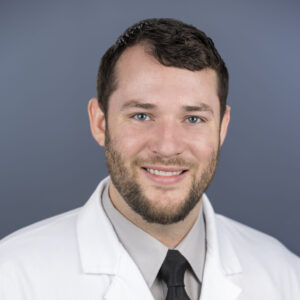 Dr. Kyle Fink is an Associate Professor at the University of California, Davis Health. His laboratory specializes in cell and gene therapy approaches for rare neurodevelopmental disorders, with published work on genome editing and transcriptional reprogramming strategies for conditions including Angelman syndrome, Huntington’s disease, FOXG1 syndrome, and PPP2R5D-related neurodevelopmental disorder.
Dr. James (Jim) Dowling — Penn Medicine
PURA syndrome is caused by mutations in one of the two copies of the PURA gene. This results in approximately 50% of the normal amount of PURA being made and/or producing 50% of the normal amount of function. This reduction in expression/function then causes the clinical challenges associated with PURA syndrome. An attractive therapeutic strategy is to increase the amount of PURA made in cells. We are pursuing the strategy of viral vector mediated gene therapy to try and achieve this. Specifically, we are formulating the PURA gene into a delivery vehicle called AAV, providing AAV-PURA to cell and mouse models of the disease, and then measuring its ability to rescue function. Successful completion of this work will provide a novel treatment strategy for PURA Syndrome.
 Dr. Jim Dowling is a clinician-scientist focused on gene discovery and therapy development for childhood and adult neurogenetic and neuromuscular diseases. He is currently a Professor of Genetics and Neurology at the University of Pennsylvania and Director of the Penn Neurogenetics Therapy Center. He is also a staff clinician and scientist at the Children’s Hospital of Philadelphia. He continues to hold adjunct positions at the University of Toronto and the Hospital for Sick Children, where he was a staff clinician, senior scientist, and Mogford Campbell Family Chair of Paediatric Neuroscience for 12 years before joining the University of Pennsylvania.
Dr. Dowling received his BSc and MSc from Yale University and his MD/PhD from the University of Chicago. His PhD work was performed in the laboratory of Elaine Fuchs. He did his residency in child neurology at Children’s Hospital of Philadelphia and completed postdoctoral research with Jeff Golden (UPenn) and Eva Feldman (University of Michigan). Before coming to Penn, he was an assistant professor at the University of Michigan from 2009-2013 and an associate and then full professor at the University of Toronto from 2013-2025.
Dr. Dowling’s clinical expertise is in childhood and adult neuromuscular and neurogenetic disorders. His research, which spans both pre-clinical and clinical aspects of translational medicine, examines questions of disease pathomechanisms and therapy development for neurogenetic conditions across the lifespan. His research program has been fortunate to have sustained funding from several sources, including NIH, and he has author/co-authored more than 200 manuscripts.
Built on Ongoing Collaboration
These four grants don’t stand alone. The research they fund builds on — and will continue alongside — the broader work of our Scientific Advisory Board, our Global Research Network of scientists and clinicians, and our partner foundations and research collaborators around the world. Much of that work has been underway for years, often outside the scope of what the Foundation directly funds, and all of it is essential to the progress we’ve seen and the progress still to come. The 2025 grants are a new chapter in a much broader story — one written by many hands, and one we are honored to be part of.
Looking Ahead — Together for PURA 2026
 This moment – marked by four funded grants, a new patient registry and biobanks in the U.S. and Germany, represents the largest research investment in our history. It is a turning point, and our journey is just beginning.
We are deeply grateful to our PURA families, friends, and supporters who made Together for PURA 2024–2025 our most successful campaign ever. None of this progress would be possible without you.
But momentum like this requires sustained support. The research we’ve helped launch is generating new questions – questions that will lead us closer to answers, treatments, and hope. Continued funding is essential to keep this progress moving forward.
Our 2026 Together for PURA Campaign is launching soon. Our goal is to raise $300,000 to support critical research, empower families, and strengthen advocacy efforts worldwide. Reaching this goal requires all of us – families and extended families, friends and neighbors, local businesses and corporate partners, restaurants, creators, and community leaders, and everyone who believes that rare does not mean alone. When we come together, our impact grows exponentially.
A defining moment in this campaign will be October 23 — PURA Syndrome Awareness Day – when we will rally our community to raise awareness, share stories, and inspire collective action and giving. This day reflects not only how far we’ve come, but what’s possible when we move forward together.
We can do this. And you can be part of it. By joining Together for PURA 2026, you are accelerating research, supporting families today, and lighting the path toward a brighter future tomorrow for the PURA community.
How you can help
To make this fundraiser a true success, we need your help! We’re looking for team captains to rally family, friends, co-workers and their communities to join the effort.
Getting started is easy – Start your own team by visiting our 2026 Together for PURA Fundraising page, scroll down to “Team Members” and click the blue “Fundraise” button. Once your team is set up, you can invite others to join or simply share your personal link or QR code to start raising funds right away.
Every effort and every contribution makes a meaningful difference!
Thank You!
To every donor, family member, and volunteer who made Together for PURA 2024–2025 our most successful campaign ever — thank you. To the board members, Scientific Advisory Board, Global Research Network, partner foundations, clinicians, and research collaborators who carry this work forward every day — thank you.
Ten years ago, PURA syndrome was barely on the map. Today, a global community is driving the science that’s redefining what’s possible for our families – because of you.
Join the 2026 Together for PURA Fundraising Campaign
_________________________________________
The PURA Syndrome Foundation is a 501(c)(3) nonprofit organization supporting, educating, and empowering families impacted by PURA syndrome worldwide, and supporting the research that will deepen our understanding of this rare disorder.